
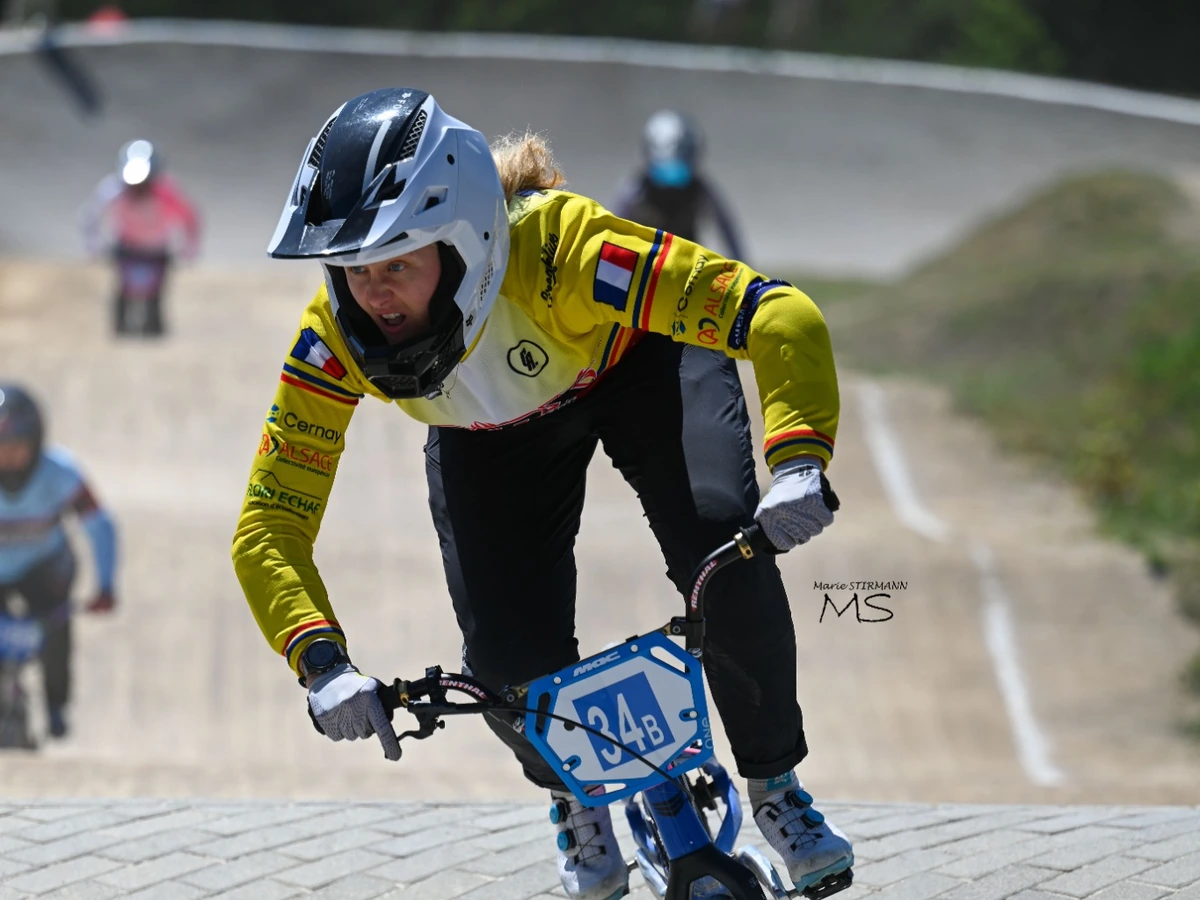
October 2025. I had been riding BMX for roughly a year, training every Friday evening at my club in Cernay and already completely hooked. There was just one thing I barely knew: racing.
I was usually the only woman in my group, so I had almost no idea where I stood against other female riders. There was really only one way to find out.
On 19 October 2025, I lined up at the Trophée Grand Est in Cornimont (my first real BMX race).
Cornimont: just to see what racing felt like
I arrived without big expectations. I simply wanted to discover the pre-grid, motos, other riders beside me, the gate dropping and what it felt like to fight for space in a group.
Riding a line alone in training and riding into the first turn with seven other people are completely different things.
And somehow, in my first race, I reached the final. I finished fourth.
It was not an extraordinary result on paper. For me, though, it changed the whole picture: I clearly lacked race experience, but I could still fight near the front.
Back home, I looked at my 20-inch bike and my cruiser and thought about the things I had done in the race that I probably would not have attempted alone in training.
And an idea started to appear: qualifying for the European Championships might not be completely impossible.
A simple goal: earn the right to go
A European final or a podium was not even part of the conversation at that stage. I just wanted to qualify and earn the right to be there.
From then on, my winter changed.
From one BMX session a week to proper preparation
I joined the performance group at the club and gradually moved from one BMX session per week to two. That meant making room elsewhere.
Skiing and enduro had already given me technical confidence and competition experience. What they had not given me enough of was something much less glamorous (and very important in BMX): sprinting.
So I reduced some enduro sessions and started dedicated sprint work: one hour in my street, standing starts, short accelerations and repeated start-block drills.
It was not the most glamorous part of training, but it produced some of the clearest progress.
The Challenge France Nord-Est became the structure of the season
My 2026 calendar centred around the three Challenge France Nord-Est rounds:
- Tavaux, 11–12 April;
- Messigny-et-Vantoux, 2–3 May;
- Calais, 30–31 May.
I raced both 20-inch and cruiser each weekend.
BMX tracks are quite spread out in the Grand Est region, so racing frequently means spending a lot of time driving. I deliberately limited the total number of races I entered.
That meant less race experience, but I relied on what skiing and enduro had already taught me about stress, mistakes and competition.
Learning the tracks before race day
During the winter, our coach Charly Gaillard organised training sessions in Tavaux and Messigny.
The aim was simple: arrive on race weekend already familiar with the track.
We did not travel to Calais beforehand because it is nearly seven hours from Alsace.
Tavaux: the race that changed everything
In January, I was almost counting how many training sessions I had left before Tavaux.
I had no idea who would show up or how fast the other women were. The week before the race, I was so nervous I had stomach pain.
Then came the first moto.
The gate dropped.
I came out in front.
And I won.
I genuinely did not understand what had just happened.
But that race released most of the tension I had built up over the previous weeks.
I eventually finished second in cruiser. On Sunday, I finished fourth in 20-inch.
Why I was stronger on the cruiser
A pattern quickly appeared: my results were consistently better on the cruiser.
I felt naturally stable on the larger bike and seemed to have more speed and “length” at the bottom of the start hill.
On the 20-inch bike, I sometimes felt I was missing just a little speed or gearing. In BMX, a few centimetres can completely change how you enter the first turn.
And if I entered behind someone, my lack of experience in traffic became obvious.
Messigny: learning how to race other people
By Messigny, I understood my level better.
The stress had changed. I was no longer asking whether I could keep up. I started asking how I could beat specific riders.
I finished third in 20-inch and again reached the podium in cruiser.
I also learned something important: the other riders were learning me as well.
One of my direct rivals had a coach who noticed that I repeatedly attacked the inside line in the first turn. The next time, that space was not quite so available.
Riding BMX fast and racing BMX well are not the same skill. I was still learning the second one.
Calais: no longer racing just to see what happens
Between Messigny and Calais, training volume increased and the goal became clearer.
I wanted to beat my closest rival consistently and reduce the gap to the fastest rider in the category.
After the final Challenge France Nord-Est round in Calais, the standings confirmed it:
I finished first overall in Women 25+ and second overall in Cruiser Women 30+.
A few months earlier, I had entered Cornimont simply to discover racing.
Now I was qualified for major national and international Challenge events, including the European Challenge in Sarrians.
Becoming a national-level rider after one racing season
Another consequence came much faster than expected: I reached national rider status.
At my age, that felt unusual.
On some races I would now line up against riders who had been doing BMX since childhood and had more than a decade of specific experience.
I started BMX as an adult.
I genuinely expected it to take another two years to reach that level.
My knee surgery will interrupt that momentum for a while, but after rehabilitation I intend to use that status to race a Coupe de France and, if everything goes well, a European Cup.
What this season taught me
This first season reminded me of something I often see with patients and athletes: a distant goal becomes much more realistic once it is broken into smaller steps.
In October, “qualifying for Europe” almost sounded like a joke.
Then came:
- a second BMX session each week;
- dozens of sprint sessions;
- start practice;
- track-specific training;
- a first moto win;
- podiums;
- mistakes in the first turn;
- and a huge amount learned race by race.
The first objective was complete.
I had qualified.
Next stop: Sarrians
A few weeks later, I headed to the south of France.
From 24 to 28 June 2026, Sarrians hosted the UEC BMX Racing European Championships and European Challenge.
The next chapter is here: my first BMX European Challenge in Sarrians, including the heatwave, mental preparation and my first European semi-final.
This racing experience also influences how I work in sports physiotherapy in Basel. Competition preparation, injury, confidence and return to sport are things I know from both sides.
Leave a Reply