
By Millie Brecheisen, physiotherapist in Basel. Updated: 1 October 2026.
Dizziness during sport may start after an impact, when standing up, while sprinting or during quick head movements. These situations tell different stories. Before changing training, it is important to distinguish vertigo, unsteadiness, disturbed vision and feeling faint.
The word dizziness is too broad to guide treatment
An athlete may describe dizziness when they mean spinning, unsteadiness, blurred vision, feeling faint or light-headedness. The timing changes the clinical reasoning completely: during a sprint, after an impact, with quick head movements, when standing up or in a visually busy gym.
After an impact or concussion
Vestibular symptoms are common after concussion and can delay return to sport. The Amsterdam consensus recommends active, multimodal care rather than prolonged rest [1]. Recent publications suggest assessing for BPPV, eye movement problems, vestibular deficits, neck pain and exercise intolerance [4].
When migraine mainly shows up through movement
Vestibular migraine can cause vertigo, nausea and movement sensitivity, sometimes without headache. In an athlete, heat, lack of sleep, dehydration, stress and irregular training loads may combine with a predisposition to migraine. Diagnosis remains medical and should not be replaced by a simple label of fatigue [2].
When the pattern suggests an orthostatic or autonomic problem
Palpitations, darkening vision and feeling faint on standing or during recovery may suggest orthostatic intolerance. Exercise is often used as a non-pharmacological treatment in POTS, but programmes need individualisation, especially when exercise tolerance is very limited [3].
Cardiac, metabolic, haematological and heat-related causes should also be considered according to the context. Fainting during exertion requires medical assessment; it should not initially be managed as a vestibular problem.
What does a sports physiotherapy assessment involve?
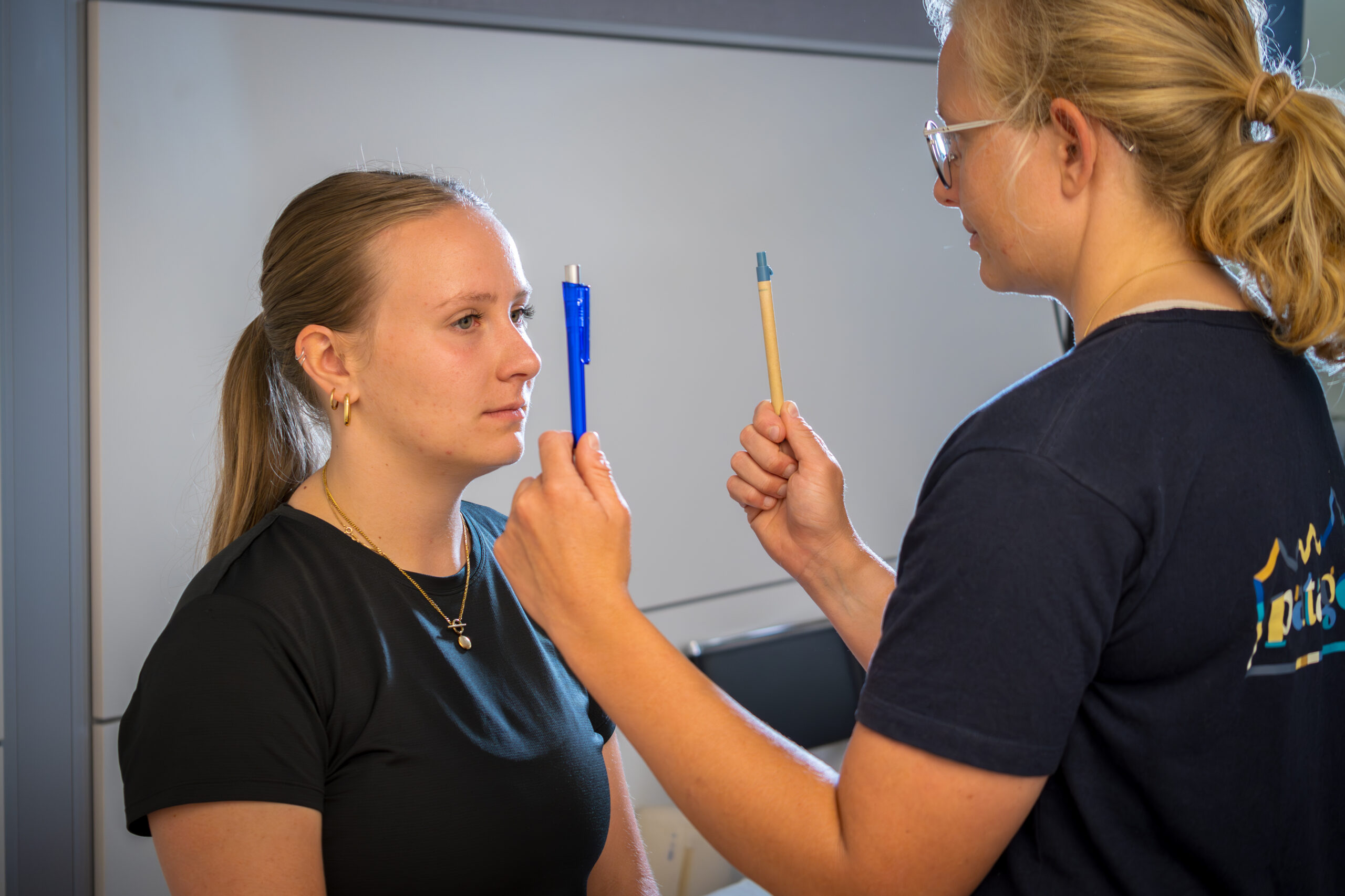
Assessment can relate symptoms to head movements, balance, vision, the neck and exertion. After concussion, a graded exercise test may help prescribe the load. When a vestibular problem is suspected, gaze stability and dynamic walking become central.
Return to sport needs to reproduce real demands: acceleration, changes of direction, dual tasks, the visual environment and fatigue.
Clinical clues that guide the assessment
Ask whether symptoms occur during exertion, immediately afterwards, on standing or with head movements. After concussion, combine vestibular and cervical assessment with exercise testing. Fainting during exertion, chest pain or unusual palpitations require more than a simple vestibular treatment approach.
The episode’s timeline changes the next step
Recording what happens before, during and after the episode is often more useful than simply writing ‘dizziness during sport’.
- After an impact: stop activities that risk further injury and have a possible concussion assessed.
- With quick head movements: assess gaze, balance and any hearing symptoms.
- With darkening vision, chest pain, unusual palpitations or loss of consciousness: investigate a medical cause before prescribing exercise load.
After assessment, the return can gradually incorporate the demands of the sport. Cycling, running and sports involving changes of direction challenge the visual, vestibular and circulatory systems differently.
An individual assessment in Basel
An assessment in Basel can relate symptoms to your sport’s demands and guide an adapted return once causes requiring medical advice have been assessed. Describe the timing of episodes, any impacts and differences between activities. These details guide the choice of tests.
Frequently asked questions
Is dizziness during sport dangerous?
It can have a benign cause, but fainting, chest pain, a neurological deficit or an unusual acute symptom requires medical assessment.
Why am I fine cycling but not running?
Visual demands, impacts, head movements and the orthostatic response differ between activities.
Can I keep training?
That depends on the cause. Progressive training can be therapeutic in some conditions, but situations requiring medical advice must be identified first.
Related articles
- Dizziness and vestibular rehabilitation in Basel
- Dizziness after concussion: vestibular, visual, neck or exercise related?
- Vestibular migraine: dizziness with or without a headache
- Dizziness on standing: low blood pressure, POTS or the inner ear?
Scientific references
[1] Patricios JS et al. Consensus statement on concussion in sport: Amsterdam 2022. Br J Sports Med. 2023. Read the reference on PubMed.
[2] Villar-Martinez MD, Goadsby PJ. Vestibular migraine: an update. 2024. Read the reference on PubMed.
[3] The use and effectiveness of exercise for managing POTS: scoping review. 2024. Read the reference on PubMed.
[4] Israel KK, Steenerson KK. Management of Vestibular Symptoms in Sports-Related Concussion. Neurologic Clinics, 2026. Read the reference on PubMed.
This information explains possible mechanisms and rehabilitation options. Diagnosis and treatment depend on an individual assessment.
Leave a Reply