
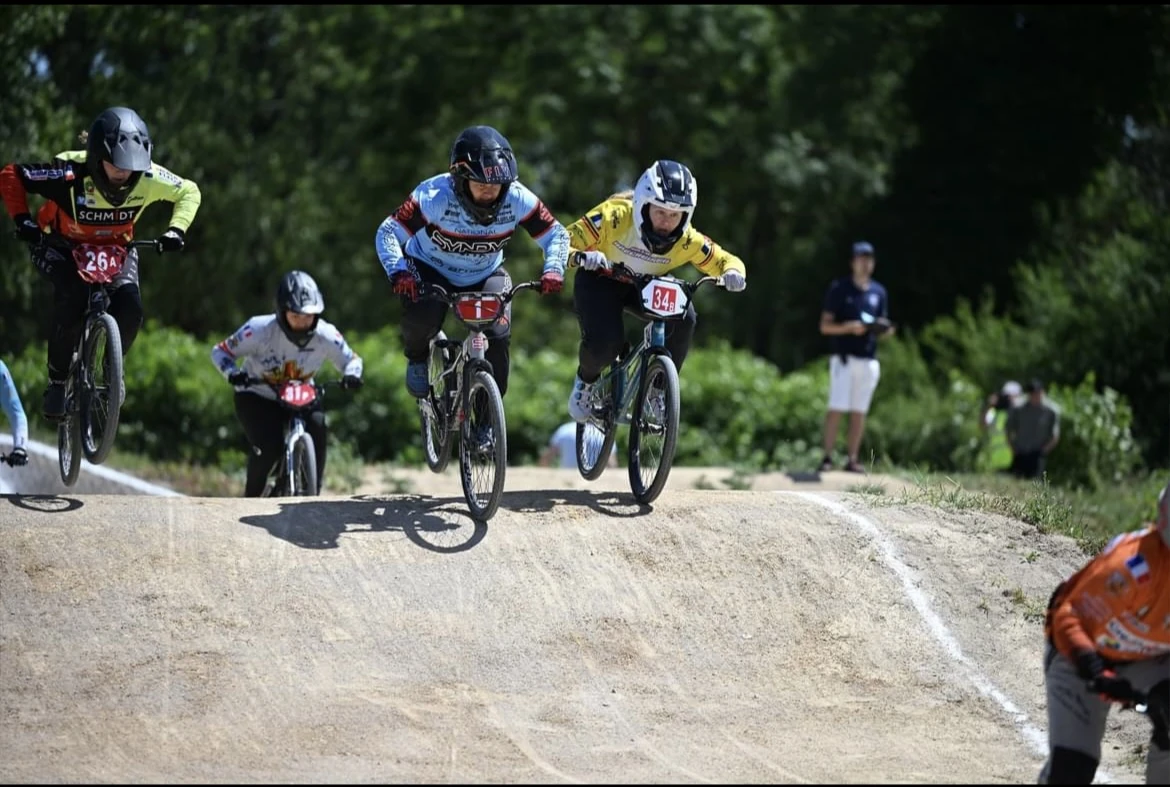
A few weeks earlier, I barely knew where I stood compared with other women in my category. Now I am in Sarrians. After my first BMX racing season and qualification through the Challenge France Nord-Est, I am suddenly lining up among riders from all over Europe.
My qualification in 2026 was for cruiser only. To race the 20-inch European Challenge, I would have needed access to national-level French races, which I did not yet have at the start of the season.
I enjoy the cruiser, but I still prefer 20-inch: smaller wheels, a more playful bike and a format that feels closer to how modern BMX tracks are designed.
Sarrians: an immediate change of scale
I drive down on Tuesday 23 June feeling extremely nervous.
Sarrians is a true international BMX venue, with SX-style infrastructure, a Challenge start hill and a much bigger hill for Championship categories.
The big hill? Definitely not one of my ambitions.
This is only my seventh race weekend ever.
Before Sarrians, I had raced in Cornimont, Baume-les-Dames, Tavaux, Messigny, Calais and Cernay. That is very little race experience before an international event.
Mental preparation: learning to picture myself at the front
In the weeks before Sarrians, I did intensive mental preparation work with Manon Crozet.
The timing was far from ideal. We had roughly one month for work that would normally deserve several.
Even so, it changed something important. I realised how often I had gone into races thinking I’ll just do my best (which sounds sensible, but in BMX can also be a very comfortable way of placing yourself behind before the gate even drops).
In BMX, you need to be able to picture yourself at the front. Not because you are certain you will win, but because if eight riders are fighting for the same first turn and you have already placed yourself behind them mentally, part of the race is gone before it starts.
That was the shift for me: I was allowed to believe I could be at the front.
A heatwave changes the schedule
Then the heatwave gets added to the equation. Training sessions are moved earlier to reduce exposure, which makes sense physiologically but does not necessarily make the logistics easier.
I sleep in my van at the event campsite. The nights are hot, the sleep is average, and some mornings the stress starts before I even reach the track: will the campsite gate open early enough for me to make the session on time?
Small constraints accumulate: heat, sleep, waiting, food, nerves and unusual timings.
Practice: one big scare
During the first training session, I manage a good number of laps and deliberately work on technical passages: manuals, pumping and rhythm.
Then comes the first significant roller.
On one manual attempt, I hit the front wheel hard.
The bike throws me forward and for a moment in the air I lose that reassuring sense of where my body actually is.
I get away with it physically.
Mentally, however, something changes.
The mental block
To ride that first feature well, I need to leave the start fast.
And after the scare, I start holding back without really deciding to.
Only slightly. But in BMX, a few percent less commitment can change the whole line.
As a sports physiotherapist, I know this mechanism well: after a threatening experience, knowing rationally that you can perform a movement does not always mean your nervous system is ready to let you do it freely.
Friday morning: suddenly I am third
Because of the heat, racing starts extremely early.
My initial goal is simple: get through the motos.
I genuinely expect to be somewhere near the back.
First moto: third.
Second moto: third again.
My entire perception of the event changes.
I am not just here to say I took part. I am genuinely in the race.
After the motos, I am eighth in the intermediate ranking and qualify for the semi-final.
A few months earlier, I was racing my first small regional event.
Six hours of waiting
There are roughly six hours between the morning motos and the semi-finals.
Six hours is a very long time when you know the next forty seconds may decide the rest of your day.
I do not have an Airbnb or a properly cool place to rest. It is hot, the week has been tiring and the goal has changed.
In the morning, I simply wanted to qualify.
Now I want the final.
The semi-final: wanting it a little too much
I arrive in the pre-grid with much more pressure than in the morning.
I want to prove the good motos were not a coincidence.
And the first obstacle is still in my head.
I do not ride my best race.
I cannot find the same freedom I had earlier.
I finish sixth in my semi-final. The top four advance.
My European Challenge ends there.
Disappointed, but not really
Of course I am frustrated in the moment.
Once you realise a final might actually have been possible, all the “what if” questions appear.
But another fact matters just as much:
Sarrians is only my seventh race weekend.
And I have just raced a European BMX semi-final.
Watching the final differently
That evening, I stay to watch the finals with the other riders.
I am especially happy to see Anaïs Merland, the rider I had been chasing all spring, produce a strong result in the Cruiser Women final.
A direct rival can also be one of the best reference points for your own progress.
Now I want more
I leave Sarrians with one very clear thought:
I want to come back.
I want a European final.
I want to race the World Challenge.
I want more race experience.
Before that, I need knee surgery.
It is frustrating because the progress is becoming tangible, but it is also necessary if I want to build over several seasons rather than only think short term.
So the next objective is surgery, rehabilitation and returning to the bike.
After that, the direction is clear.
Come back. Make a European final. And race at a World Championship.
What Sarrians also taught me professionally
This experience reminded me that performance is never only about strength or technique.
Fear after a scare, sleep, heat, waiting, race experience and pressure can all influence what an athlete is able to produce.
Those are exactly the kinds of factors that also matter when returning to sport after injury.
I bring that personal experience into my work in sports physiotherapy in Basel.
Leave a Reply