
By Millie Brecheisen · Updated 17 November 2026.
A knee that gives way, a hesitant single-leg stance and feeling less secure when you cannot watch your foot may describe different problems. After ACL injury, stability involves ligaments, muscle capacity, sensation, vision, attention and confidence. Assessing these together helps identify what rehabilitation should address.
Mechanical instability and functional insecurity
Mechanical instability refers to insufficient ligament restraint assessed clinically. Functional problems can remain despite a stable graft: weakness, pain, swelling, difficulty braking or fear of reinjury. These factors can overlap. A new giving-way episode after trauma, marked swelling or locking needs reassessment rather than being labelled poor proprioception.
What does proprioception contribute?
Sensory information from the joint, muscles and other tissues helps the nervous system interpret limb position and movement. Injury, swelling and changes in muscle recruitment can alter that control. The system may place greater weight on visual information.
This does not mean all the receptors have been destroyed, or that standing on a wobble cushion simply grows them back. Proprioception is one part of sensorimotor control. Strength, planning and the demands of the task matter too.
What does research show about visual reliance?
A 2024 scoping review found evidence of increased visual reliance, particularly in ACL-deficient knees. Evidence after reconstruction was less consistent. Adding a visual or cognitive demand may reveal difficulties that a simple stance does not. However, group differences do not diagnose an individual patient. Review of visual reliance.
A 2026 meta-analysis of observational research also examines cognitive-motor performance following reconstruction. These findings make reactive tasks a plausible rehabilitation component. They do not establish that a particular visual-training programme independently prevents another ACL rupture.
How can physiotherapy investigate this?
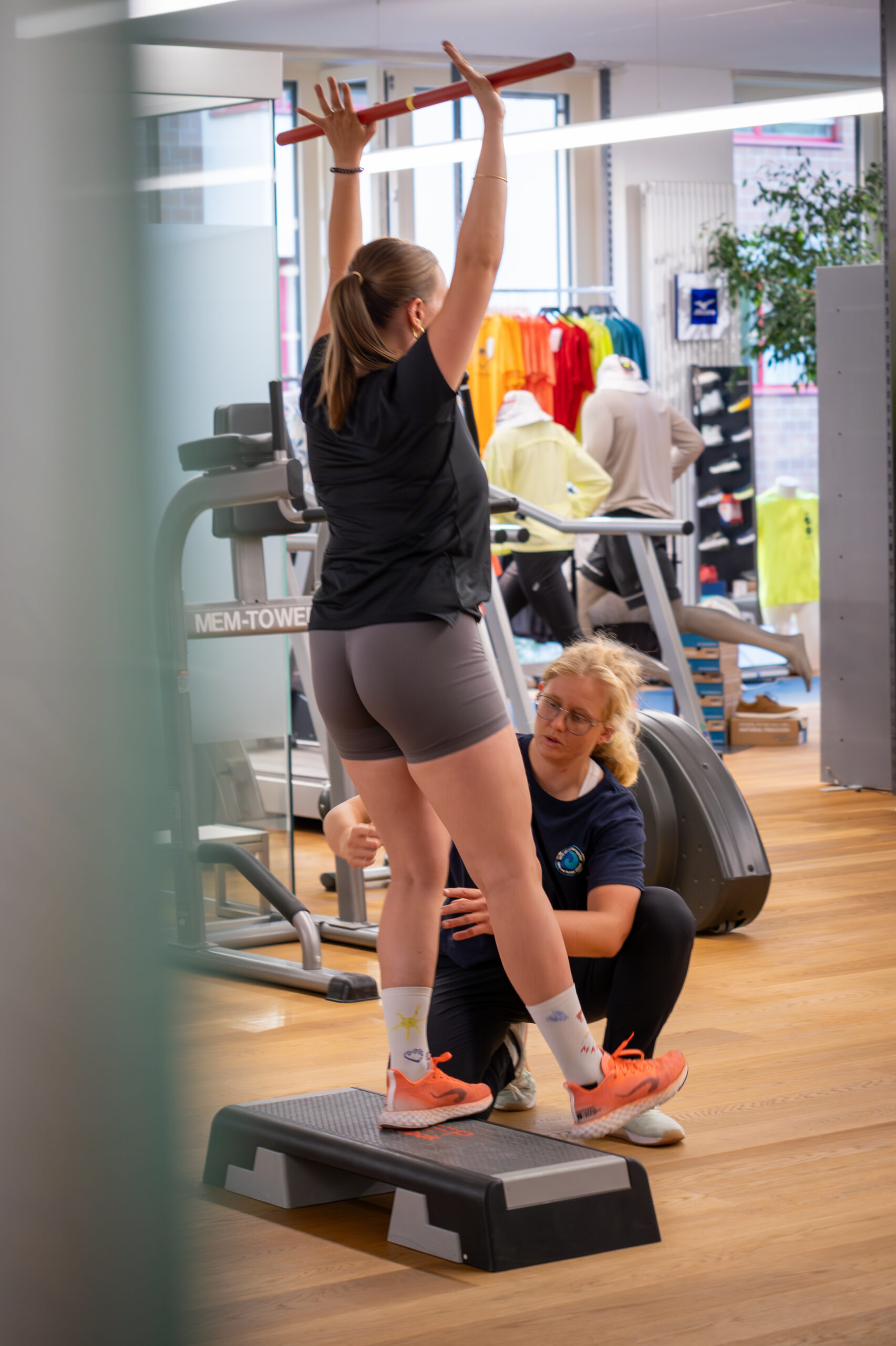
The assessment starts with the history of giving way and, when appropriate, ligament examination, swelling, range, strength and movement control. A safe task can then be modified with a visual target, head movement, decision or dual task. The aim is to find a repeatable difficulty relevant to your activity.
Comparing eyes-open and eyes-closed performance can explore visual contribution in a safe setting. It cannot isolate the ACL or inner ear. Ankle function, foot sensation, pain, fatigue and apprehension can also affect performance. A poor balance-cushion test therefore does not establish a vestibular disorder.
Rebuilding stability beyond a balance cushion
The 2025 review by Chen and colleagues supports some benefits of proprioceptive training after ACL reconstruction, with variable study quality and protocols. It complements strength work rather than replacing it.
- Build sufficient strength and control in simple, secure tasks.
- Progress reach, speed, braking and landing demands.
- Add visual information, decisions and dual tasks while movement remains appropriately controlled.
- Later, restore unpredictable sporting situations with a managed fatigue load.
Eyes-closed tasks or visual perturbations should not be introduced on an unsafe unsupported stance. Postoperative restrictions also apply. The task should create a useful learning challenge, not simply repeated losses of balance.
Where does dizziness fit?
These systems interact, but a knee injury does not automatically imply vestibular disease. Dizziness, bouncing vision while walking or significant symptoms with head movement may warrant a separate assessment. That provides a possible clinical link with vestibular rehabilitation in Basel without confusing distinct diagnoses.
Frequently asked questions
Can a clinically stable knee still feel unreliable?
Yes. Ligament restraint, muscle capacity and confidence are different findings. The task is to identify what limits movement, not dismiss the symptoms as imaginary.
Does everyone need visual training after ACL injury?
No standard package suits everyone. ACL rehabilitation remains individualised; sensory and cognitive demands are selected according to assessment and sporting requirements.
Related reading
- Knee injuries and pain in Basel
- ACL graft choices: what changes in rehabilitation?
- Modified Lemaire procedure: why add it to ACL reconstruction?
- Knee pain without a clear diagnosis: what can physiotherapy do?
Knee rehabilitation matched to your goals in Basel
At Physio-Sport Brecheisen, Holbeinstrasse 75, 4051 Basel, assessment brings together symptoms, capacity and activity goals. Bring existing medical reports and postoperative instructions.
Book an appointment · Directions to the practice
Scientific sources and verified information
- Is Visual Reliance Increased in Athletes After ACL Injury? Scoping review, 2024.
- Chen et al. Proprioceptive training after ACL reconstruction. Systematic review and meta-analysis, 2025.
- Neurocognitive Alterations Following ACL Reconstruction: systematic review and meta-analysis of observational studies, 2026.
- Kotsifaki et al. Aspetar clinical practice guideline on rehabilitation after ACL reconstruction. BJSM, 2023.
Leave a Reply