
By Millie Brecheisen · Updated 17 November 2026.
For a younger athlete with a focal knee cartilage injury, the practical question is how to regain sporting capacity while protecting the repair. “Cartilage reconstruction” includes several different procedures. Microfracture, nanofracture and transplantation do not create identical tissue and should not share an interchangeable rehabilitation protocol.
Microfracture and nanofracture: stimulating repair
These techniques create small channels in the bone beneath the cartilage defect so that marrow elements can contribute to repair tissue. Nanofracture uses smaller, deeper perforations than conventional microfracture. “Nano” does not mean treatment at a nanometre scale or guaranteed restoration of normal native cartilage.
Repair tissue produced through marrow stimulation differs from native hyaline cartilage. Nanofracture may be combined with a scaffold, including in some AMIC procedures. A 2024 technical publication explains one method, but is not a trial proving superior patient outcomes. Comparative and return-to-sport evidence specifically for nanofracture remains limited.
What other procedures may be considered?
Depending on defect size, depth and location, options may include osteochondral grafting, chondrocyte implantation or another restoration technique. Leg alignment, meniscal function, ligament stability and the underlying bone also matter. Being young is not sufficient on its own to justify surgery. Targeted imaging needs to be interpreted with symptoms and examination findings.
A 2025 randomised trial involving 65 adults found no superiority of microfracture over debridement for small, isolated femoral defects at two years. This does not answer every surgical indication and was not a nanofracture trial. A separate review highlights long-term limitations of microfracture for larger defects. Randomised trial and long-term review.
How is rehabilitation organised?
The surgical instructions should specify the treated area, technique, permitted weightbearing and movement, and any associated repair. A femoral-condyle defect and a patellofemoral defect experience different loading patterns. This table describes a progression framework, not personal clearance. A 2023 rehabilitation review documents substantial variation between published protocols.
| Stage | Physiotherapy priorities | Progression requirements |
|---|---|---|
| Protect while maintaining permitted movement | Monitor swelling, maintain allowed range, activate muscles and train other areas; use crutches as instructed. | Respect surgical limits and monitor wound healing and symptoms. |
| Rebuild capacity | Progress authorised weightbearing, walking, adapted cycling and strengthening within selected ranges. | Acceptable joint response during the session and the following day, with procedure-specific progression. |
| Prepare impact and sport | After strength and control work, introduce running, jumping, braking and sport-specific tasks. | Respect biological time, joint response, functional testing and the treatment team’s instructions. |
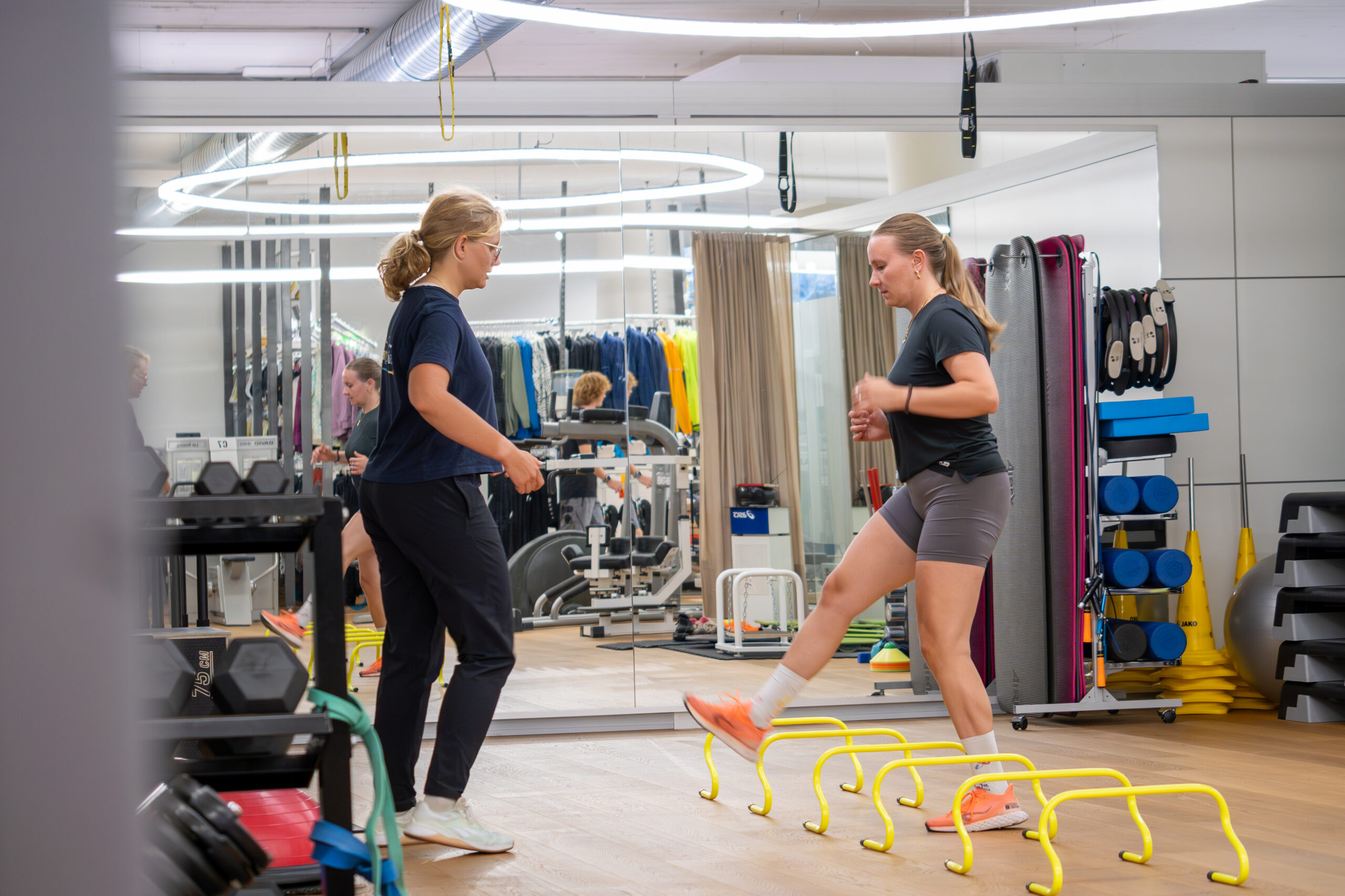
Some procedures protect weightbearing for several weeks, and impact progression is measured in months. These are broad time scales, not a universal calendar. A relatively pain-free joint is not necessarily ready for jumping. Increased swelling, lost range or limping after progression should prompt a loading review.
Why movement and strength still matter
Physiotherapy maintains permitted mobility and fitness, then rebuilds quadriceps and lower-limb capacity. Allowed movement helps recovery become more than simply waiting. However, there is no basis for promising that hours of cycling or a device will make cartilage “new again”. Loading must fit the protection required. Rehabilitation adjuncts should support that progression.
What are the chances of returning to the previous level?
Kunze and colleagues’ 2025 review included 52 studies: roughly 80% returned to some sport. Returning to any sport is different from returning to the previous performance level. The populations and procedures varied, so this is neither an individual probability nor a nanofracture-specific estimate. Associated injuries, sport demands and rebuilding training also influence the outcome. Return-to-sport review.
Where can you seek specialist assessment in Basel?
The Universitätsspital Basel’s official knee and sports orthopaedic service information, including its Bethesda site, lists cartilage surgery and reconstruction. Dr Björn Zappe’s crossklinik profile on the Merian Iselin Klinik website also lists cartilage reconstruction. These establish areas of practice, not routine use of a particular nanofracture technique or suitability for your case.
The Basel research group involving Mumme and Martin has also studied implants derived from nasal cartilage cells. Its 2025 multicentre trial compared two implant maturation approaches, rather than all standard operations. Current access and eligibility need confirmation with the specialist team. Original trial.
Frequently asked questions
Can I cycle after nanofracture?
Only within the restrictions for your operation. Range, resistance and loading matter; easy stationary pedalling and outdoor climbing are different tasks.
What should I bring to physiotherapy?
The operation report, postoperative instructions, weightbearing restrictions and your activity goals. These guide individual knee rehabilitation in Basel.
Related reading
- Knee injuries and pain in Basel
- Supporting knee rehabilitation: Compex, BFR, compression, cycling and strength
- Do you need a knee MRI before starting physiotherapy?
- ACL graft choices: what changes in rehabilitation?
Knee rehabilitation matched to your goals in Basel
At Physio-Sport Brecheisen, Holbeinstrasse 75, 4051 Basel, assessment brings together symptoms, capacity and activity goals. Bring existing medical reports and postoperative instructions.
Book an appointment · Directions to the practice
Scientific sources and verified information
- Kunze et al. Return to sport after knee articular cartilage restoration. Systematic review, 2025.
- Randsborg et al. Microfracture versus arthroscopic debridement: multicentre double-blinded RCT, 2025.
- Microfracture for medium-size to large knee chondral defects has limited long-term efficacy. Systematic review, 2024.
- Return to Play After Knee Articular Cartilage Restoration: Surgical Options, Rehabilitation Protocols, and Performance Outcomes, 2023.
- Focal Knee Cartilage Defect Treatment With Nanofracture and All-Arthroscopic AMIC. Technical note, 2024.
- Mumme et al. Engineered cartilage maturation in a randomized multicenter trial. Science Translational Medicine, 2025.
- Universitätsspital Basel: knee and sports orthopaedics, cartilage surgery. Official service information checked 17 November 2026.
- Merian Iselin Klinik: Dr Björn Zappe, crossklinik Basel, cartilage reconstruction. Official profile checked 17 November 2026.
Leave a Reply