
By Millie Brecheisen, physiotherapist in Basel. Updated: 1 October 2026.
Vertigo starts suddenly. It continues, walking becomes difficult and even small movements cause nausea. Vestibular neuritis can produce this pattern, but diagnosis first requires medical assessment. Recovery then brings a different task: regaining stable vision and dependable balance.
An acute vestibular syndrome
Vestibular neuritis, now often described within acute unilateral vestibulopathy, typically causes continuous vertigo of sudden onset, with nausea, unsteadiness and nystagmus. The first days can be very distressing. Initial diagnosis is medical because a stroke can produce a similar presentation. A central cause must be considered and excluded when the pattern is compatible with an acute vestibular syndrome.
Why spinning eases while unsteadiness may remain
A unilateral vestibular impairment creates an imbalance between signals from the two inner ears. The central nervous system then begins to compensate. Acute spontaneous vertigo usually improves before gaze stability and dynamic balance have fully recovered. Some people therefore remain unsteady when walking, see less clearly during head movements or avoid moving quickly.
A 2024 systematic review supports early vestibular rehabilitation in acute peripheral vestibular syndrome, reporting improvement in dizziness related disability in the short and longer term [1].
Prolonged rest is not a recovery strategy
Symptom relieving treatment may be necessary at the very beginning. Later, remaining still for too long can limit opportunities for compensation. Rehabilitation gradually reintroduces head movements, walking, balance tasks and daily activities. The dose needs to stimulate adaptation without causing hours of symptoms after every session.
Recent evidence also questions the idea that corticosteroids are consistently superior in every acute vestibulopathy. The medical decision depends on the situation and the timing of treatment [2].
What can vestibular physiotherapy assess?
Depending on the stage, assessment may include gaze stability, dynamic visual acuity, balance with different sensory information, walking with head movements and exercise tolerance. Instrumented tests such as vHIT, caloric testing and VEMPs usually form part of specialist ENT or neurological assessment.
Follow up also helps identify a course that does not fit straightforward compensation: secondary BPPV, vestibular migraine, marked visual dependence or developing PPPD.
Returning to work, cycling or sport
Progression depends on symptoms and the demands of the activity. For someone who plays sport, walking through the clinic without dizziness is only one step. Recovery also needs gaze stability, quick direction changes, tolerance of visual environments and confidence with head movements. In Basel, rehabilitation can be adapted to specific work or sporting demands.
Clinical points that help make sense of the assessment
The key pattern is continuous acute vestibular symptoms, rather than repeated attacks lasting seconds. Initial diagnosis must exclude a central cause. Follow up considers head impulse responses, nystagmus, gaze stability, balance and walking. vHIT, caloric testing and VEMPs can be useful when indicated by ENT or neurology.
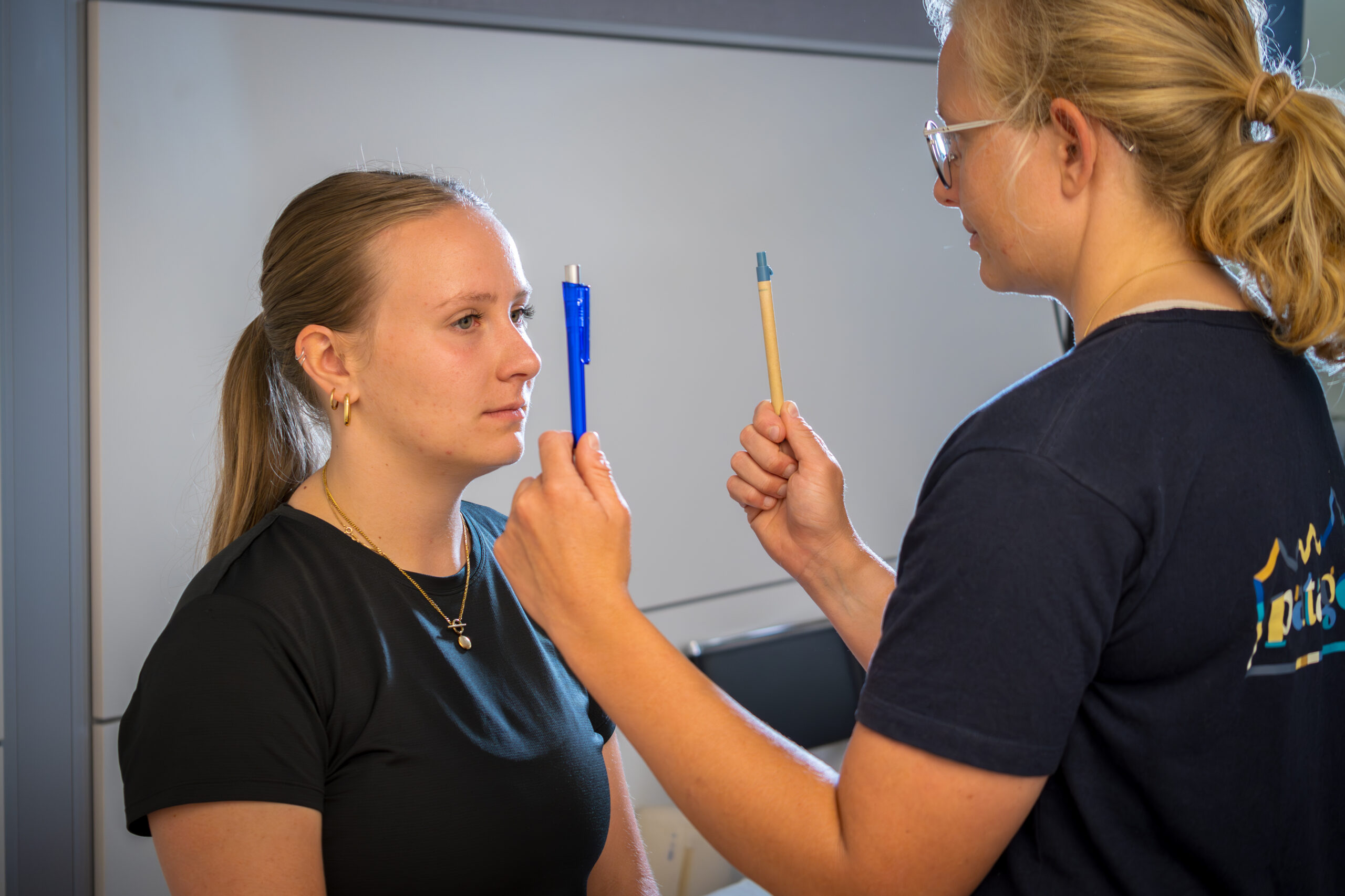
HINTS is intended for particular acute vestibular syndromes and must be performed by a trained clinician in the appropriate setting. It is not a self test or a test for every brief dizzy spell. A new acute episode requires medical assessment even without obvious weakness [3].
From the first steps back to daily activities
Once the medical diagnosis has been established, progression may begin with very simple tasks. Safety and actual tolerance guide the starting point.
- Resume short walks, using support or a walking aid when needed.
- Gradually combine walking with head movements when balance allows.
- Then prepare for work or sport: speed, turns, different surfaces and visual surroundings.
An exercise that was appropriate initially may become too easy a few weeks later. Progression follows function, rather than keeping the same exercise sheet indefinitely.
A physiotherapy assessment in Basel
After medical diagnosis of vestibular neuritis, vestibular rehabilitation in Basel can support a return to walking, work and sport. Reports from the initial assessment help clarify the deficit. Progression is then adapted to the activities you want to regain.
Frequently asked questions
How long does vestibular neuritis last?
The acute phase often lasts a few days, but unsteadiness and movement sensitivity may persist for weeks or longer, depending on compensation.
Should I avoid moving my head?
After the acute phase, gradual exposure to movement is generally useful. Dosage depends on symptoms and assessment findings.
Why am I still dizzy after the severe spinning has stopped?
The end of spontaneous vertigo does not mean that the vestibulo ocular reflex, balance and sensory integration have fully recovered.
Related articles
- Dizziness and vestibular rehabilitation in Basel
- Unilateral vestibular hypofunction: symptoms and rehabilitation
- Persistent dizziness after BPPV or vestibular neuritis: what next?
- Oscillopsia: when your vision bounces as you walk
Scientific references
[1] Agger-Nielsen HE et al. Early vestibular rehabilitation training of peripheral acute vestibular syndrome: systematic review and meta-analysis. Front Neurol. 2024. Read the reference on PubMed.
[2] Diagnosing and treating acute and chronic dizziness: new approach in 2024. Rev Med Suisse. 2024. Read the reference on PubMed.
[3] Edlow JA et al. Guidelines for reasonable and appropriate care in the emergency department 3 (GRACE-3): Acute dizziness and vertigo in the emergency department. Academic Emergency Medicine, 2023. Read the reference on PubMed.
This information explains possible mechanisms and rehabilitation options. Diagnosis and treatment depend on an individual assessment.
Leave a Reply