
By Millie Brecheisen, physiotherapist in Basel. Updated: 1 October 2026.
You veer while walking, look for something to hold or keep watching your feet. The room never spins. Balance problems can still make everyday life difficult. The assessment needs to establish which systems have become less reliable and in which situations.
Balance depends on several systems working together
Standing and walking require continuous integration of vision, the vestibular system, proprioception, strength, motor control and neurological abilities. Someone can therefore be very unsteady without any spinning sensation. Instead, they may describe veering, feeling less secure, walking better in good light or needing to watch their feet.
Everyday clues guide the assessment
Difficulty mainly in darkness can suggest visual dependence or a vestibular deficit. Unsteadiness on uneven ground may reveal a problem with sensory integration. Difficulty turning quickly, walking while doing another task or recovering after losing balance may reflect other components.
Unilateral and bilateral vestibular disorders frequently cause chronic balance disability [2, 3], but they represent only part of the differential diagnosis.
What does a balance assessment involve?
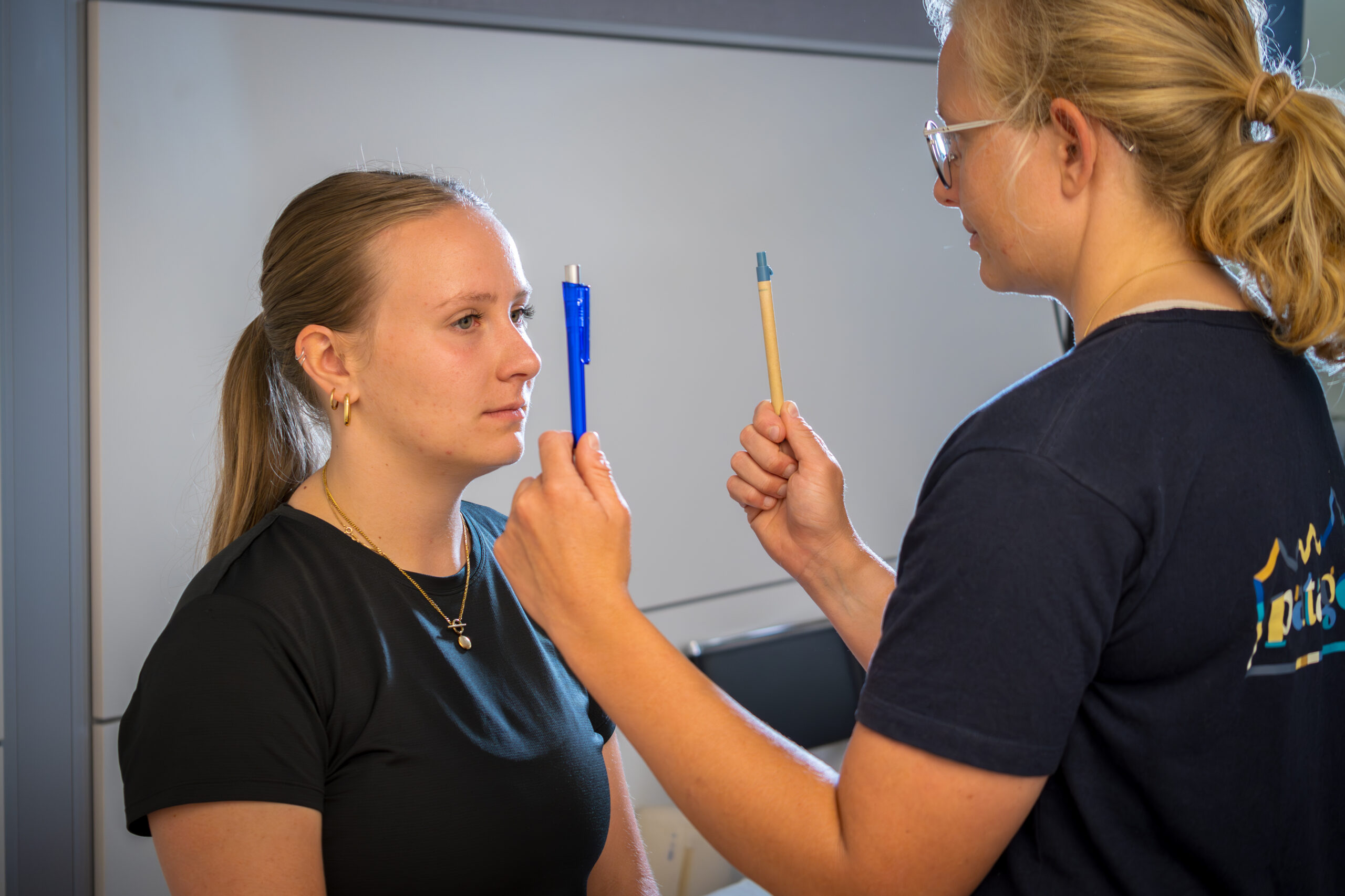
Assessment may use static and dynamic tasks, change the base of support, vision and surface, add head movements or a cognitive task, then observe walking. Some people also need assessment of strength, sensation, postural responses and mobility.
The purpose is not to produce a score for its own sake. It is to understand the conditions in which the balance system loses its reserve.
How to train balance effectively
Sensorimotor and proprioceptive programmes can improve several balance measures, particularly in older adults, according to a 2024 meta-analysis [1]. However, the programme must match the deficit. Closing your eyes on a cushion is not a universal treatment.
For an active person, progression can include fast walking, changes of direction, obstacles, outdoor surfaces, head movements and tasks specific to sport or work. Safety remains the priority.
When to seek medical advice
Sudden unsteadiness, unexplained falls, weakness, new sensory changes, suspected cerebellar involvement or progressive deterioration require medical assessment. A balance problem should not automatically be attributed to ageing.
Clinical clues that guide the assessment
Useful approaches include varying vision, surface, base of support, head movements and dual tasks. Tests such as CTSIB, tandem stance, Timed Up and Go, Functional Gait Assessment or Mini-BESTest can measure different components. The test should match the person’s age, sporting level and fall risk.
Connect the test to an activity that is actually difficult
A balance test becomes useful when it explains a limitation in everyday life. Someone may manage a simple task in the clinic yet still struggle outdoors.
- Compare performance in good light, reduced light and on different surfaces.
- Observe turns, obstacles, head movements and, where appropriate, a simultaneous second task.
- Track a meaningful activity: stairs, public transport, outdoor walking or a sporting task.
An improved score should come with greater safety or independence. Exercise selection takes fall risk, sensory abilities and strength into account.
An individual assessment in Basel
A balance assessment in Basel starts with the situations that cause difficulty: outdoor terrain, stairs, turns, darkness or sport. Exercises can combine sensory work, strength and walking. Bring relevant examination results and mention recent falls or near-falls.
Frequently asked questions
Can I have a vestibular problem without spinning dizziness?
Yes. Unsteadiness and difficulty in darkness may be more noticeable than rotational vertigo.
Why do I watch my feet when walking?
This may be a strategy to increase visual information when other sensory inputs are less reliable.
Is strengthening my legs enough?
Not always. Strength matters, but sensory integration, vestibular control and dynamic walking may also need specific training.
Related articles
- Dizziness and vestibular rehabilitation in Basel
- Unilateral vestibular hypofunction: symptoms and rehabilitation
- Bilateral vestibulopathy: unsteadiness in the dark and bouncing vision
- Dizziness on standing: low blood pressure, POTS or the inner ear?
Scientific references
[1] Pšeničnik Sluga S, Kozinc Z. Sensorimotor and proprioceptive exercise programs to improve balance in older adults: a systematic review with meta-analysis. European Journal of Translational Myology, 2024. Read the reference on PubMed.
[2] Karabulut M et al. Chronic symptoms in unilateral vestibular hypofunction: systematic review and meta-analysis. 2023. Read the reference on PubMed.
[3] van Stiphout L et al. Bilateral vestibulopathy: a clinical update and proposed diagnostic algorithm. Frontiers in Neurology, 2023. Read the reference on PubMed.
This information explains possible mechanisms and rehabilitation options. Diagnosis and treatment depend on an individual assessment.
Leave a Reply