
By Millie Brecheisen, physiotherapist in Basel. Updated: 1 October 2026.
After whiplash, your neck hurts. Dizziness naturally draws attention to the cervical spine. That may be relevant, but the injury can also involve vestibular or visual problems, or a concussion. The assessment needs to keep this broader picture in view.
Several systems may be affected after a neck injury
Whiplash can cause neck pain, headaches, unsteadiness, visual disturbances and dizziness. A 2023 review highlights that cervical proprioceptive, vestibular and oculomotor systems all contribute to postural control and may be involved after a head and neck injury [1].
This helps explain why a normal X-ray does not always answer someone’s functional concerns. It also shows why concluding that the symptoms come from the neck without an assessment would be too simplistic.
The neck may explain only part of the picture
Altered cervical proprioception can disturb the brain’s representation of head position. Recent studies describe several subgroups of cervicogenic dizziness and emphasise the need for differential diagnosis [2]. An injury may also trigger BPPV, reveal vestibular migraine or involve a concussion.
What is useful to assess?
Neck movement and pain alone are insufficient. Assessment may include head position control, eye movements, balance, walking, vestibular tests and responses to combined head, eye and trunk movements. If concussion is possible, exercise tolerance and cognitive symptoms should also be considered.
Rehabilitation often combines several approaches
When the neck contributes to symptoms, treatment may combine mobility, motor control, proprioception and strengthening. If vestibular or visual deficits are also present, specific rehabilitation is added. Recent work on cervicogenic dizziness supports an integrated approach rather than a strict division between cervical and vestibular problems [3].
Progress should translate into practical activities: driving, looking around, working at a screen, walking through a crowd or returning to sport.
Take warning signs seriously
After injury, neurological signs, an unusual headache, weakness, marked loss of sensation, double vision or sudden deterioration require medical assessment. Arterial dissection or a neurological injury is rare, but must not be missed.
Clinical clues that guide the assessment
Useful areas include cervical mobility, sensorimotor control, joint position error, balance and eye movements, alongside screening for BPPV and signs of concussion. The mechanism is often mixed. After a significant injury, the label ‘cervical’ should not be used to avoid a necessary neurological assessment.
The assessment may be spread over several appointments
After injury, completing every test at once may unnecessarily overload someone with substantial symptoms. The clinical questions can be prioritised.
- First check that the situation allows safe examination and neck movements.
- Investigate positions that trigger brief spinning, then gaze, walking and cervical control according to tolerance.
- Record the response to each group of tests and complete the remaining areas during follow-up.
A postponed part of the assessment has not been judged normal. It still needs assessment, or referral to ENT or neurology if the symptoms justify it.
An individual assessment in Basel
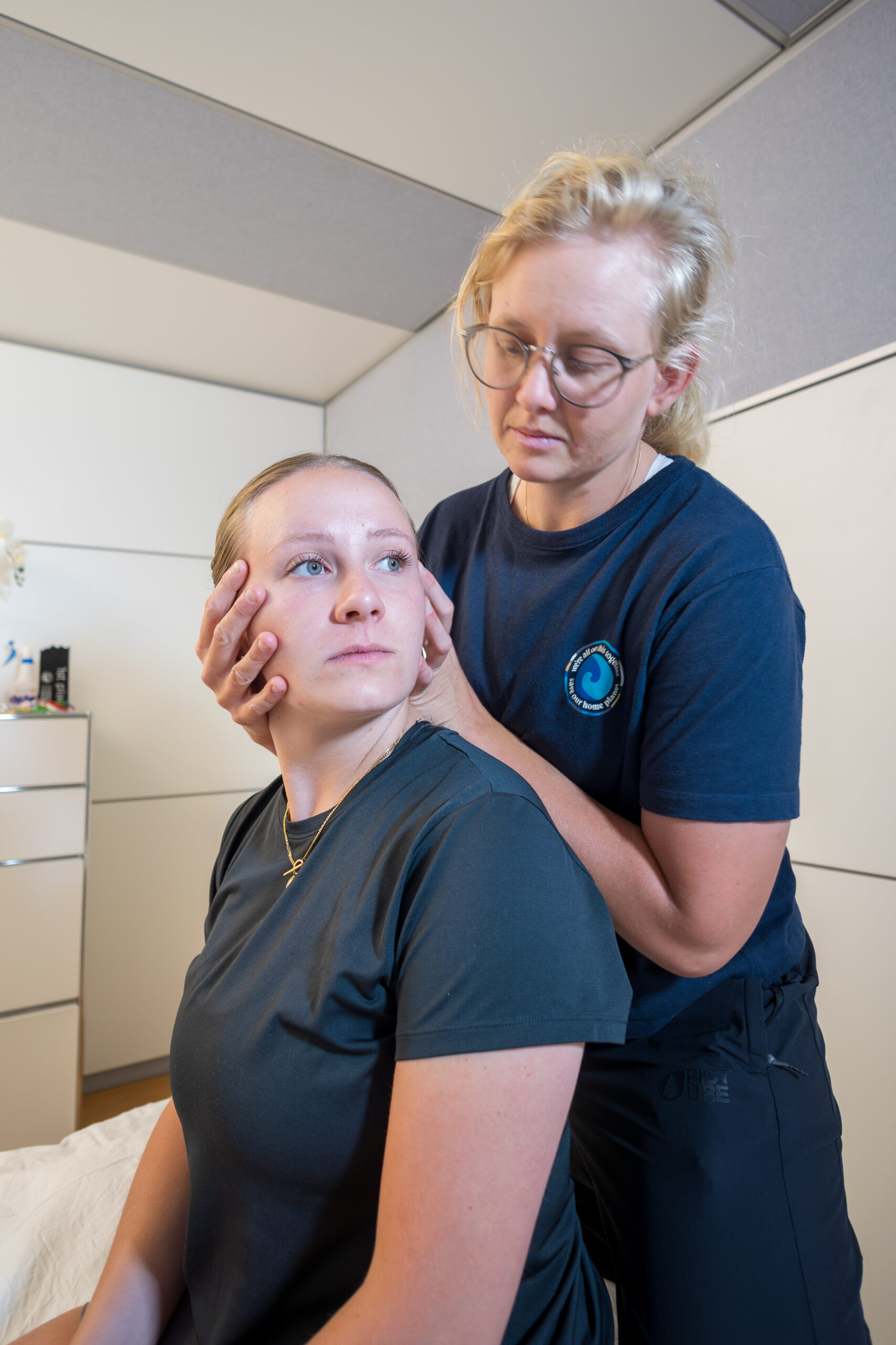
An assessment after whiplash in Basel can bring together cervical, vestibular and visual examination. It is adapted to your tolerance and the available medical information. Symptoms after the accident, previous treatments and activities that remain limited help prioritise the next steps.
Frequently asked questions
Why am I dizzy when my neck MRI is normal?
Symptoms can involve functional and sensorimotor changes without a visible structural lesion, but other causes still need to be excluded.
Neck massage or vestibular exercises?
That depends on the assessment. Both may be useful when both systems contribute.
Can whiplash cause BPPV?
An injury can be associated with BPPV. Positional tests are indicated when symptoms are brief and triggered by changes in position.
Related articles
- Dizziness and vestibular rehabilitation in Basel
- Dizziness and a tense neck: what role can the neck play?
- Dizziness after concussion: vestibular, visual, neck or exercise related?
- BPPV: brief spinning when lying down or turning your head
Scientific references
[1] Post-Traumatic Craniocervical Disorders From a Postural Control Perspective: Narrative Review. 2023. Read the reference on PubMed.
[2] Gill-Lussier J et al. Proprioceptive Cervicogenic Dizziness Care Trajectories: Scoping Review. 2023. Read the reference on PubMed.
[3] De Hertogh W et al. Dizziness and neck pain: cervicogenic dizziness perspective. 2025. Read the reference on PubMed.
This information explains possible mechanisms and rehabilitation options. Diagnosis and treatment depend on an individual assessment.
Leave a Reply