
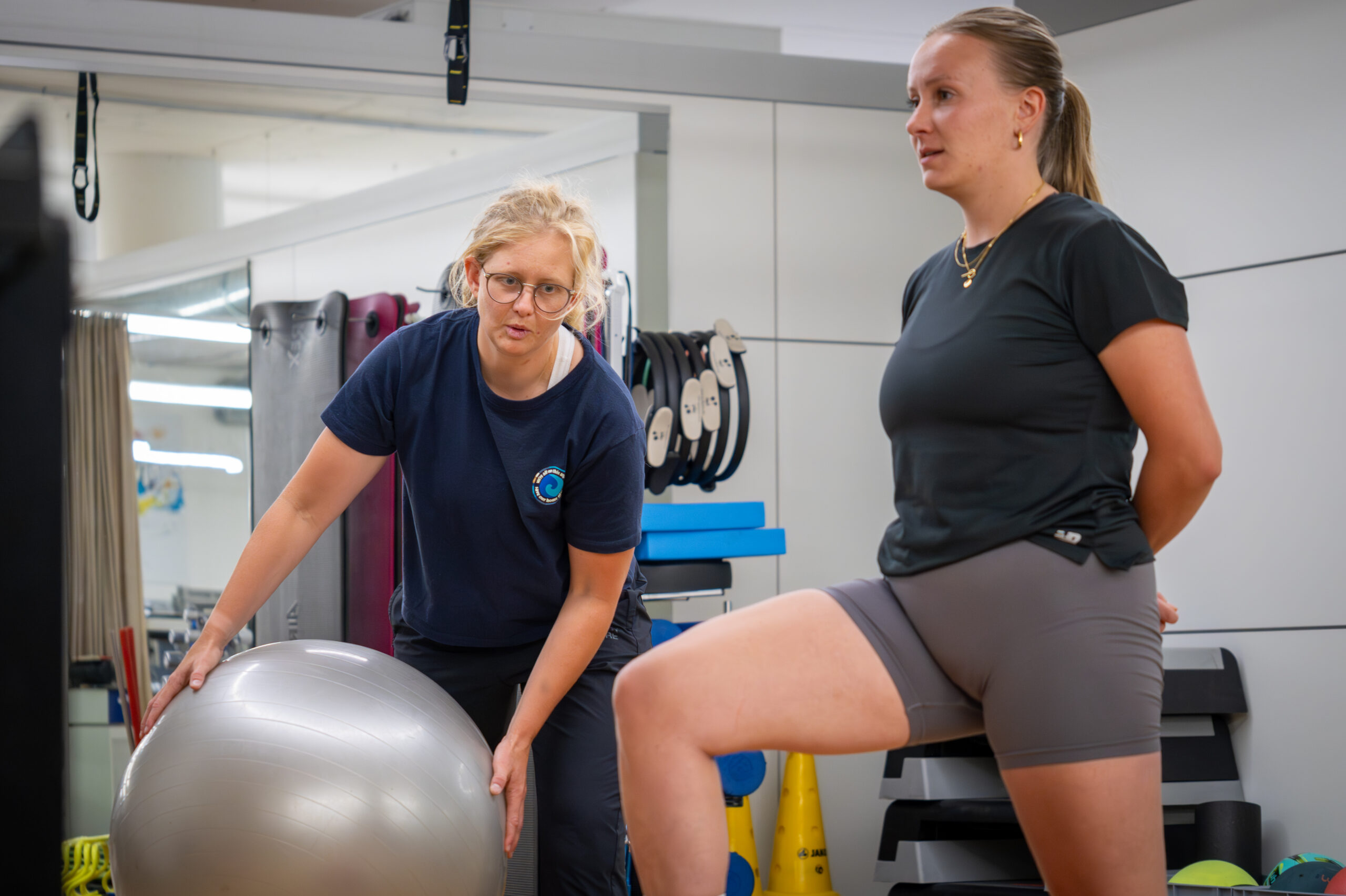
By Millie Brecheisen, sports physiotherapist in Basel.
If an athlete has no pain, are they ready to train and compete? Not necessarily. Pain relief is a milestone, but it does not show whether physical capacities match the demands of the sport.
There is no universal clearance test
A systematic review of 114 studies on lower-limb return-to-sport testing found many approaches and no universally validated battery. Most evidence concerns the knee, particularly ACL injury; evidence for hip and ankle is thinner. Tests should fit the injury and the sport.
Five areas to consider
1. Strength: Depending on the injury, quadriceps, hamstrings, calves and hips may be measured. Comparing limbs is useful, but can hide loss of strength in the supposedly healthy limb.
2. Jumping: Distance, height, repeated landings and movement strategy reveal different capacities. Recent reviews suggest hop tests alone predict individual reinjury risk poorly.
3. Speed and change of direction: Pivoting sports require progressive acceleration, braking, reaction and sport-specific movement.
4. Fatigue: Control early in a session may differ from control after repeated effort.
5. Confidence: Fear of reinjury affects participation and movement. Discussion and suitable questionnaires complement physical tests.
From testing to participation
Sport, position, planned training load and opportunities for a gradual return all matter. The team physician consensus describes a multifactorial, collaborative decision. Tests support a reasoned progression; they do not guarantee that injury will not recur.
Explore sports rehabilitation in Basel. Book a sport-specific assessment.
An example of a sensible testing sequence
After a knee injury, I start with healing, symptoms, range of movement and strength. Higher-demand tasks follow only when that foundation is adequate. A good hop distance is less reassuring if it comes from a painful or weak starting point.
- First, measure strength and simpler movement tasks against the athlete’s actual training goal.
- Then add landings, repeated jumping, speed and braking where the assessment supports them.
- Finally, plan the progression into training and competition, considering next-day response and the athlete’s confidence as well as test scores.
Frequently asked questions
Is there one test that tells me I can play?
No. A decision usually combines strength, function, sport-specific tasks and the athlete’s confidence.
Does 90% symmetry mean I am ready?
Not necessarily. It says little about absolute strength, movement quality, fatigue or the demands of your sport.
Can I test with some lingering pain?
It depends on the injury and purpose. Significant pain or an abnormal response to load may invalidate a test.
Leave a Reply