
By Millie Brecheisen, physiotherapist in Basel. Updated: 1 October 2026.
Treatment for visually induced dizziness starts with a practical question: which situation needs to become manageable again? Shopping, screen work, walking through a station and returning to sport require different progressions. An optokinetic video may help, but it is not a rehabilitation programme on its own.
Before treating VID, establish what you are treating
Visually induced dizziness, or VID, describes dizziness, disorientation or unsteadiness triggered by busy or moving visual scenes. Supermarkets, stations, crowds, scrolling screens, video games and traffic are common examples. VID may occur within vestibular hypofunction, vestibular migraine, PPPD or concussion [2].
The first step is therefore not to start an optokinetic video. The context, other deficits and associated diagnoses need to be assessed.
The central principle: gradual, specific exposure
The nervous system needs to relearn how to tolerate visual movement without producing a disproportionate response. Start with a load from which the person recovers quickly, then gradually increase complexity, speed, duration and combinations with head or body movements.
The aim is not to make the person feel ill. A session that provokes hours of symptoms is not automatically more effective. Progression needs to remain repeatable.
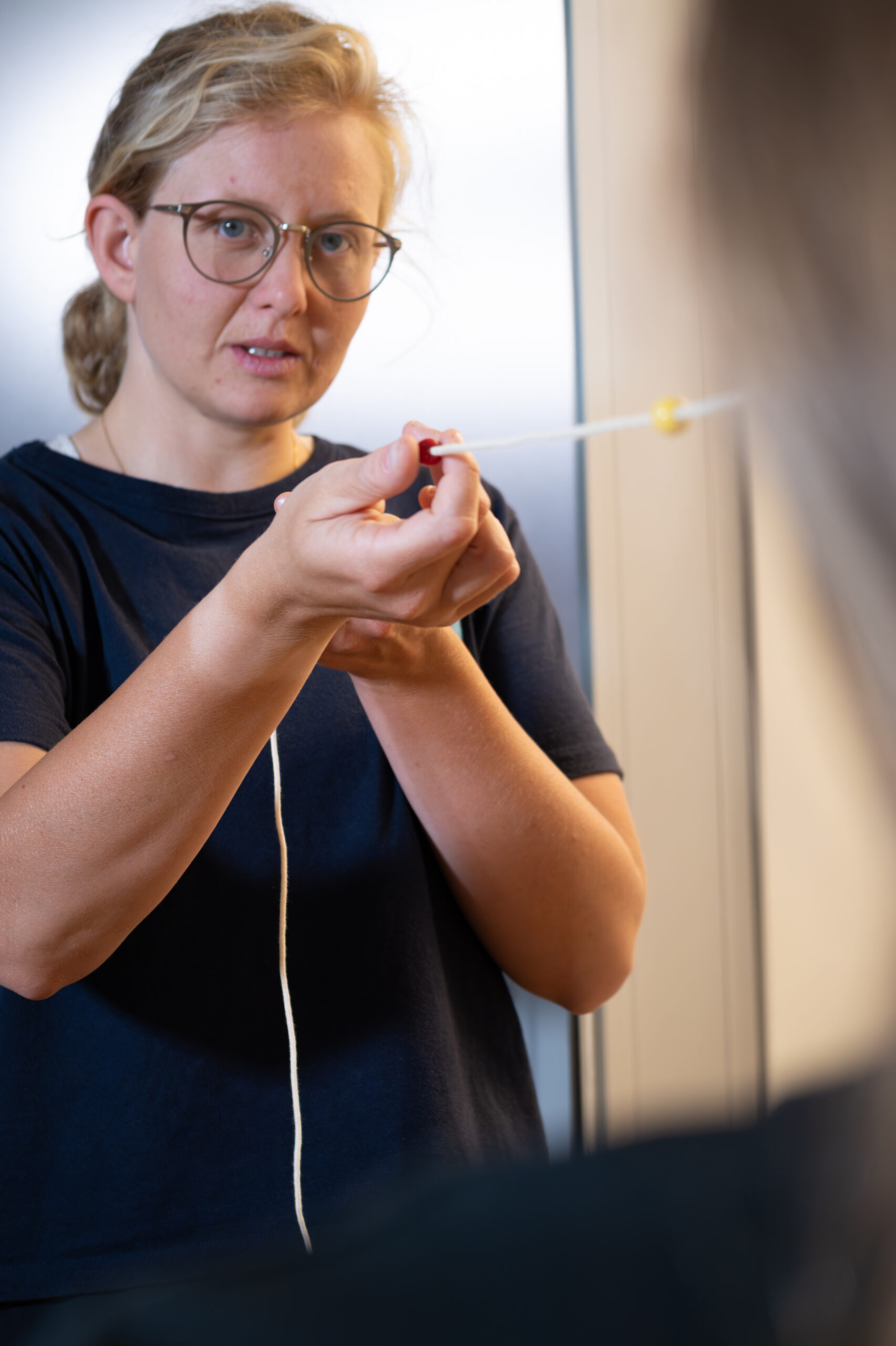
Optokinetic stimulation
Optokinetic stimuli create controlled movement across the visual field. A 2024 systematic review analysed eleven randomised trials. Symptoms improved in groups both with and without optokinetic stimulation. In the meta-analysis, the additional benefit of optokinetic stimulation was not statistically significant. This tool may therefore be considered within an individualised programme, but its superiority and optimal dosage have not been established [1].
In practice, optokinetic stimulation is a way to control the exercise demands. It can target a direction, speed or degree of visual complexity, before the work is transferred to functional tasks.
Build a session that reflects the real difficulty
Someone who struggles in supermarket aisles needs more than watching moving stripes on a screen. Walking, head turns, visual searches, changes of speed and dual tasks can gradually be combined. For an athlete, rapid movement and peripheral visual information can be added. For an office worker, tolerance of screens and switching between windows may take priority.
When VID is part of PPPD
In PPPD, visual dependence is part of a broader disorder. A 2024 review of non-pharmacological treatments found small to moderate effects across different approaches and highlighted the variability of protocols [3]. Combining vestibular exposure, education, physical activity and, according to the presentation, psychological or medical care can be useful.
Measure the response that matters
Follow the ability to shop, use transport, work on a screen or walk through a crowd, rather than exercise-provoked symptoms alone. Useful progression makes real situations less demanding and reduces avoidance.
Clinical clues that guide the assessment
Adjust stimulus speed, visual field size, duration, posture and head movement separately. Record the symptom peak and, especially, recovery time. Useful progression improves shopping, screen use, transport or sport; it does more than increase tolerance of a video in the clinic.
An example of functional progression, without a universal dose
For someone who struggles in a supermarket, progression can be organised around that task. The following describes an approach, not a protocol to apply alone without assessment.
- Start with a simple visual stimulus in a stable position and a manageable load from which recovery is possible.
- Gradually add head movement, standing or walking, changing one variable at a time.
- Then transfer the work to a short visit to a real location, tracking the tolerated duration and recovery.
Difficulty also depends on visual field size, speed, duration and scene complexity. If the symptom burden rises for a sustained period, adjust the load and reassess associated factors.
An individual assessment in Basel
VID rehabilitation in Basel can form part of a vestibular assessment to select visual demands and the activities to regain. Associated migraine, PPPD or hypofunction changes the programme. Follow-up considers real life as much as the response to exercises in the clinic.
Frequently asked questions
Is optokinetic stimulation essential?
No. It may be useful, but functional exposure, balance and head movements often form part of the programme.
How many symptoms should an exercise provoke?
There is no universal dose. The aim is tolerable stimulation with sufficiently quick recovery to allow regular progression.
Can VID be treated with videos alone?
That is rarely optimal. Transferring the work to walking, head movements and real environments is essential.
Related articles
- Dizziness and vestibular rehabilitation in Basel
- Dizziness in supermarkets and on screens: understanding VID
- PPPD: understanding persistent dizziness and its treatment
- Vestibular migraine: dizziness with or without a headache
- Unilateral vestibular hypofunction: symptoms and rehabilitation
Scientific references
[1] Law JH, Koh HY, Kua A. Optokinetic stimulation in the rehabilitation of visually induced dizziness in people with vestibular disorders: A systematic review. Clinical Rehabilitation, 2024. Read the reference on PubMed.
[2] Clinical characteristics of visual motion hypersensitivity: systematic review. 2023. Read the reference on PubMed.
[3] Suica Z et al. Comparative effectiveness of non-pharmacological treatments in patients with persistent postural-perceptual dizziness: a systematic review and effect sizes analyses. Frontiers in Neurology, 2024. Read the reference on PubMed.
This information explains possible mechanisms and rehabilitation options. Diagnosis and treatment depend on an individual assessment.
Leave a Reply