
By Millie Brecheisen, physiotherapist in Basel. Updated: 1 October 2026.
After a concussion, the word dizziness does not yet tell us what to treat. Some people struggle with head movements. Others with screens, standing up or exercise. Several mechanisms may coexist, and rehabilitation needs to match that pattern.
One symptom does not identify the affected system
Dizziness after concussion can reflect several mechanisms: peripheral vestibular impairment, eye movement or visual sensitivity, a neck problem, traumatic BPPV, vestibular migraine or exercise intolerance. These patterns can overlap. This is why the same programme for everyone after concussion is unlikely to work well.
Assessment needs several components
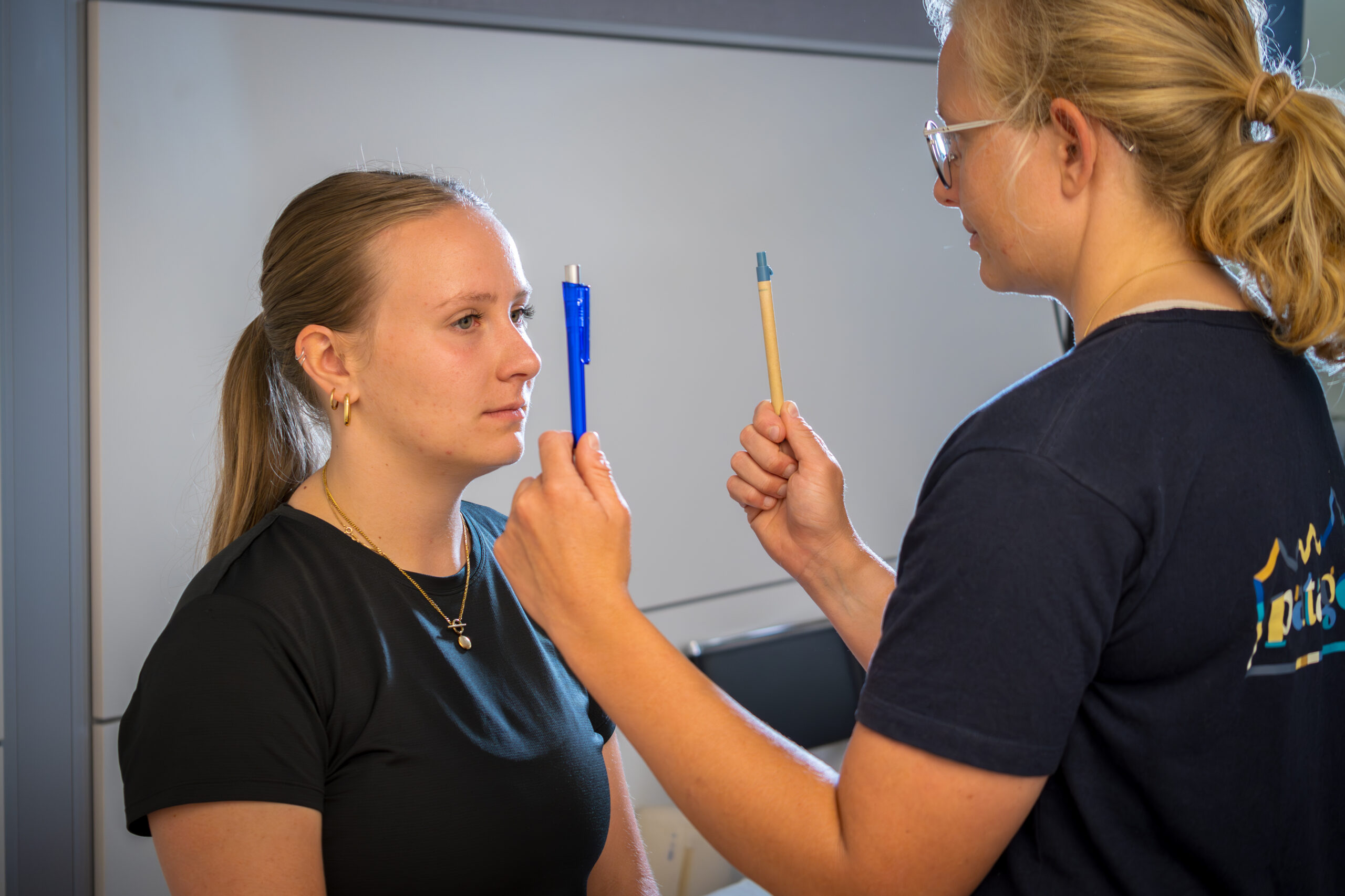
The 2023 Amsterdam international consensus recommends assessment beyond a symptom scale, including balance, vestibular and eye movement function, sleep, mental health and tolerance of activity [1]. In practice, this may involve VOMS, tandem walking, balance tests, neck movements, positional tests for BPPV and a graded exercise assessment when appropriate.
For someone with severe symptoms, not everything needs testing on the same day. Assessment can be spread over several sessions to avoid unnecessary overload.
Why vestibular rehabilitation may help
A meta analysis published in 2024 found a modest but significant improvement in dizziness related disability after vestibular rehabilitation for mild traumatic brain injury [2]. This benefit was present at the end of treatment, but not significantly at the two month follow up. Certainty of the findings remains low [2]. Recent approaches emphasise treatment matched to the clinical pattern, combining vestibular rehabilitation, neck care and gradually increased aerobic exercise when needed [3].
This may mean gaze stability work for one person, visual tolerance for another, or neck mobility and exercise for a third. The functional assessment should guide the exercises.
Exercise is part of treatment, not just a final test
Prolonged strict rest is no longer recommended. After the initial phase, physical activity is reintroduced gradually below the symptom threshold. For patients with exercise intolerance, a Buffalo type test may help measure the cardiorespiratory response and guide an appropriate exercise intensity in a suitable clinical setting.
For a sportsperson, returning to sport requires more than being symptom free while sitting. Movement speed, dual tasks, direction changes, visual surroundings, possible contact and cognitive demands need to be rebuilt.
When further medical assessment is needed
Worsening neurological signs, a sudden unusual headache, repeated vomiting, weakness, speech difficulty, reduced consciousness or a major new abnormality require urgent medical assessment. Persistent symptoms without progress also justify reconsidering the diagnosis.
Clinical points that help make sense of the assessment
Combine symptoms, VOMS, balance or tandem walking, neck examination, a search for BPPV and exercise tolerance. In athletes, a graded exercise test can help measure intolerance once contraindications have been excluded. A high VOMS score alone does not identify the mechanism.
Progression follows what actually limits the person
Load can be organised in stages. The programme varies with the findings and involves more than waiting for all symptoms at rest to disappear.
- Treat BPPV if found and address identified neck, vestibular or eye movement deficits.
- Build a tolerable return to screens, walking and exercise.
- Introduce sporting demands such as speed, dual tasks and visual surroundings within the return to sport protocol.
If concussion is suspected, stop the activity that carries a risk and obtain medical assessment. Returning to contact or activities with a fall risk requires medical clearance and the return to sport protocol.
A physiotherapy assessment in Basel
In Basel, an initial concussion assessment requires at least one hour. Vestibular, visual, neck and exercise assessment can be spread out according to tolerance. Bring medical reports and describe difficulties at work, in transport or during sport to help plan a useful progression.
Frequently asked questions
Does dizziness after concussion always come from the brain?
No. The neck, inner ear or BPPV may also contribute.
When can vestibular rehabilitation begin?
It may be introduced early when the clinical pattern supports it, with an appropriate dose and after complications have been excluded.
Is VOMS enough to make a diagnosis?
No. VOMS is a symptom provocation and screening tool. It forms part of a broader clinical examination.
Related articles
- Dizziness and vestibular rehabilitation in Basel
- Dizziness after whiplash: assessing the neck, eyes and balance
- BPPV: brief spinning when lying down or turning your head
- VID treatment: rehabilitating dizziness triggered by visual motion
Scientific references
[1] Patricios JS et al. Consensus statement on concussion in sport: Amsterdam 2022. Br J Sports Med. 2023. Read the reference on PubMed.
[2] Aljabri A et al. The Efficacy of Vestibular Rehabilitation Therapy for Mild Traumatic Brain Injury: A Systematic Review and Meta-analysis. Journal of Head Trauma Rehabilitation, 2024. Read the reference on PubMed.
[3] Israel KK, Steenerson KK. Management of Vestibular Symptoms in Sports-Related Concussion. Neurologic Clinics, 2026. Read the reference on PubMed.
This information explains possible mechanisms and rehabilitation options. Diagnosis and treatment depend on an individual assessment.
Leave a Reply